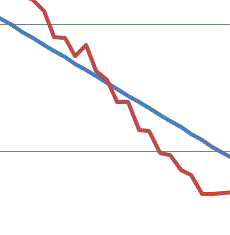
For four weeks in a row, I weighed in at exactly the same weight. No up, no down, just the same, each week. My graph looked like:
You see that flat line down there at the bottom? That’s enough for a Grade A freakout if you aren’t prepared. If you are accustomed to a steady pattern of losing weight at a pace of 1.5 – 2.0 pounds per week.
Food is the culprit, as you might guess. It isn’t that I’ve gone crazy and started eating whatever I want in all of the quantities I want. No – I’ve just relaxed a little. An extra bite here or there adds up, you know.
Also, unlike previous efforts at getting slimmer, the exercising I’m doing has a distinct muscle-building and body-composition-changing element to it. So, though my weight number got stuck in one spot for a month, my body was still changing and I’m very close to requiring another belt purchase. I’ll take some pictures soon.
All of this would be difficult to work with if there were no perspective. If I only had a visual way of seeing how much progress I’ve made, where I am relative to my ultimate goal and my ideal path, and how significant these four weeks are in the grand scheme of things.
Oh, wait.
And notice that little dip at the end? I focused on food last week and lost 1.5 pounds.
I do Crossfit, which looks insane if you’ve never done it before.
I’m also running – did 15 miles this week on top of the Crossfit.
People look at me like I’m crazy when I tell them all of that. Especially when I say “5am”. I might as well say 2am; most folks seem to think they are equivalent.
But here’s the thing – that stuff is actually not so hard. Yes, it is hard work, and it hurts sometimes, and sometimes I don’t want to go. But runner’s high is a real thing, and you can get it after non-running workouts, too. Exercising becomes addictive, and you go because you like to go, and you get up early because that’s the time you’re ready to go.
No – exercising and getting up early is not the hard part. This is the hard part:
About 14 meals here, including breakfasts. 10% – 20% of your progress will come in the gym. The other 80% – 90% comes in the kitchen. Prepping all of this is a pain in the ass, but it is done, and I’ll eat right this week.
I registered for this race last year and wound up getting lazy and not running it. This year, I didn’t register for it initially on the theory that I didn’t need races and would like to save the money. But I eventually relented and signed up. This is a charity race that Celebration Rotary does each year in conjunction with the fire department. They have a big pancake breakfast at the fire house that is free for runners but that you can buy tickets for if you don’t run. And they have a 10K and a 5K.
For those of us that are in Florida, Georgia, or the Carolinas, Hurricane Matthew is going to be a big deal. For anybody that wants to get cocky about it, I’m going to leave a video here.
When possible I try and run on the shoulder of the road rather than the sidewalk. The sidewalk “panels” can raise and buckle based on the ground shifting or tree roots. And this morning I hit one of those little lifts with my foot with about half a mile to go in my four miler. Just like that, I was on my way down.
Then something curious happened.
My abs engaged, and my hips fired forward, and my step cadence increased, and before I knew what happened, I was back on my feet and running. My hands had not even hit the ground. Now, I know that I did not look graceful (there was a car at a nearby stop sign that almost certainly saw me – wonder what they thought), and I know that I’m a clumsy oaf.
But I also know that I was able to quickly engage my body in such a way that I did not fall down. And I could feel it happening.
Seems like a silly thing, I know, but my core is stronger than it has ever been. My balance, which I suck so badly at when we work on it at the gym, is improving. And I was able to divert disaster in a way that I’m convinced I could not have done even six months ago.
I learned something this morning. Functional fitness doesn’t just mean picking up heavy things or running away from something or jumping over something. It also can mean remaining on your feet when there is every reason to bust your ass.
The one time in my life when I semi-seriously lifted weights, the guy that was teaching me had been a Division 1 football player in college. He was legitimately beasty. And his lift was the back squat – he worked on it, and on our squat day (at Gold’s Gym in Newport News, Virginia) people would come and watch him squat. He pushed me, and he taught me the technique. I fundamentally understand the back squat movement in a way I don’t most of the other things we do, because I’ve done it before.
We also don’t do it much in our gym. Crossfit focuses a lot on the front squat, and I’m sure there are good reasons for that. The front squat is much harder because of how you have to hold the bar. It requires a good front rack and a lot of grip. None of that on the back squat – put that sumbitch on your shoulders, drive through your heels, down and up.
We’ve had a drop-in working at Celebration Crossfit for the last few days – Dave from New Jersey. Dave from New Jersey looks kinda like Superman. He’s about 6′ 3″, six pack, runs faster and lifts heavier than everybody else. This morning, for squat day…
<pause>
</pause>
…I was working with him, and that’s a good thing. Going heavy is easier when you’ve got somebody there that just assumes we’re adding weight. And I just decided that today was a day I was going to push more than my body weight. Some days are not the day – today was the day.
305!
After I get through the weight and the half marathons this winter, maybe my next goal is going to be to squat something absurdly heavy within a year.
Roughly three years ago, I was in the best shape I had been in for years. I had been consistently running and using Weight Watchers for about 9 months. I had lost a bit over 50 pounds. I had just run my first half marathon (the 2013 Rock and Roll Virginia Beach). And I felt as good as I had in years. Those were exciting times. I was a runner!
Celtic Classic 5K – September 2013
And I was almost exactly the same size I am right now, in 2016.
We know how that turned out, don’t we? My weight plateaued around the first of October, on the lead-up to Ragnar Tennessee. I ran that Ragnar and basically fell off of the training wagon. I gained 10 pounds over the holidays, but did manage to run a 15k in December, another half marathon in March, and my 5k PR in April. And then it all blew to hell and I started gaining weight, and all but about 5 pounds of what I lost went right back on, just like that. So, in February of this year I made the pound-a-week commitment, and in April I joined Crossfit and got serious about the commitment – and it has worked well:
Just over five pounds ahead of schedule…
But I am beginning to feel the challenge of doing well.
What prompted me to get serious about this, now and before, was that it is truly difficult being morbidly obese out in the world. (Quick parenthetical – this is not whining or an attempt to get anybody to feel sorry for me or any other morbidly obese person. Nope I did it to myself, and I completely get that, and I own it and have and am owning it. Doesn’t change how difficult it is.) Finding clothes to fit was challenging to impossible. Airplane travel was excruciating, and that was even before it was embarrassing if I couldn’t get the seat belt buckled. Just moving around could be hard, much less keeping up with my kids. I wasn’t sleeping well. My blood pressure was high enough I could feel it, and I probably needed medicine badly. So many things are not built for obese people – rides at amusement parks, booths at restaurants, kayaks for if I want to take my kids out to experience that, mattresses that wear out in a fraction of the time they are supposed to, etc., etc., etc. … I could go on and on. These were the things I hated, and these were the things that kicked me in the ass and made me actually do something. Twice.
And almost all of that goes away for me starting at about the size I am right now. My blood pressure and other health indicators are fine. My clothes fit, and I can buy new ones in the regular-people sections of department stores. I fit in cars and airplane seats. I sleep like a rock, and I’m not scared of rides when I take my kids to Disney World. The world is opening up because I physically fit in it better.
We had our National Sales Meeting this week at work, and many of our sales team had not seen me since I began losing all of this weight. I spent the week fielding compliments and questions about what I was doing and how it was working so well and what was my secret. So I just also LOOK more normal. I notice it in pictures, too – the person in that picture is a big dude, but not a morbidly obese dude.
And this, this feeling of success, is dangerous as hell.
When I’m comfortable, there is less pressure. When I’m not constantly put out by my weight, it is easy to not be concerned about my weight. I can have that piece of bread, or slice of cake, or doughnut, or Dr. Pepper. I can order the gnocchi instead of the fish at the Italian work dinner because I have earned it, or some such nonsense. I can be less than diligent because the consequences of being less than diligent are not immediate and actively bad. For a short period of time, if I want, I can have my cake and eat it, too. In the past, that has been it all it took to push me back the other way and put the pounds back on. But this time, I anticipated the problem and did some things differently:
I set a big goal. Often you hear the advice to set small, very achievable goals – lose 20 pounds, lose 10% of your body weight, etc. And that can be good advice if you tend to be overwhelmed by a big project that will take a lot of time. What those small goals do for me is give me a feeling of having succeeded, which means I can dial back the effort. So, instead, I set a big goal – 100 whole pounds – and, now that I’ve gone a ways down that path, I’ve started to communicate that goal. I talked about it in an “about me” presentation to my company leadership last week. If asked, I told my sales team about it. I’m making a point to say “thank you, but we’re just getting started” when I am complimented. This should help keep me on my toes.
I took pictures. Lets look at this again: You can see why I might be a touch self-conscious about ever being seen without a shirt on. But, by having taken those pictures, I get to do two things. First, I get to celebrate how much progress has been made. But also, I get an objective look at how much progress there still is to go. I get real visual reminders that I’m not done yet, and not to act like it.
I have made it harder to backslide with tools. I use an alarm clock that doesn’t have a snooze button. I don’t bring things into the house that I shouldn’t be eating so that I won’t be tempted by them. I have a strict no-alcohol rule on work trips and dinners – I have nothing against the alcohol itself, but it conspires to convince me to make poor choices with food when I’m drinking it. I have gotten rid of many of my fat clothes – getting bigger means buying clothes.
Here’s the thing – I am now approaching some semblance of normal for my size and build. But I’m not even half way to where I need and want to be. So I can’t relax, even though I want to. That way a 350 pound man lies, and I’d rather not have to come face-to-face with that guy.
Hi there! It has been awhile, and you probably thought I had fallen off the wagon. That would have been a fair thought – it has happened before. BUT – nope. Just got busy. And yesterday, for the first time in awhile, I took some pictures.
So, as of Saturday morning I’ve lost 43 pounds, and things have been going well – more on that later this week. So my first reaction when I looked at the front-facing picture here was disappointment. I still look like a really fat guy.
But then it hit me – this isn’t the end, this is the middle. And this is also why we take pictures. So I went back to the original set I took and:
YIKES I WAS FREAKING ENORMOUS
No, seriously – wow.
So, obviously, you can see that my gut is significantly smaller. The overhang at the bottom is more pronounced, largely because there is less pressure to hold the whole thing up. My boobs haven’t changed much – I’m very self-conscious about my boobs – and that little roll under my arm is still there. You can really see it in my face, and particularly my cheeks.
So … progress is being made. These pictures both make me feel good about what I’ve done and also let me know that I’m still enormous and have a lot of work to do. Which is what they are designed for.
I deliberately don’t suck anything in on these pictures, though I do a lot of sucking in in my clothes. And my wife doesn’t like that I don’t smile in these pictures, even though that could make them cheesy as hell. So, for reference, and until next time:
What a boring-as-hell title for a post. Even better? This post contains screenshots of Excel spreadsheets!
You’ve been warned.
I had a conversation this morning with a guy at the gym (box? Nope … still can’t call it a box) that made me realize I’ve never talked about my thinking around how I structure the physical part of my weight loss, and the tools and processes I use for tracking that. One of the tenets of a SMART goal, and really business in general, is that your progress and results be measurable. A rule of thumb that I use in my career is that you get what you measure – if you are not measuring a particular outcome, and creating action items based on that measurement, you will not get the outcome you want. It just doesn’t happen.
Now – I’m a finance guy. Which also means I’m a process and measurement guy. That is what I do. Exercise and weight loss is a very data-rich environment. I’m a hammer, this is a nail. So – I made some plans and built some tracking and measurement goals against them.
First, and most obvious, is that I have to measure the weight loss itself. I talked about this in the Goals post that I did, but it is worth revisiting. If I am not weighing myself regularly, then it is easy to backslide. If I weigh myself too regularly, then I’m likely to be regularly disappointed by daily, water-based fluctuations in the number on the scale. I also need to see long-term benchmarks, so that I can have some perspective if I have a bad week or a very good week. So:
Measurement technique #1: Weigh myself weekly. Thursday or Friday (depends on which day I’m home after my workout). I like to do it after a workout or run, because that helps cut down on water fluctuations. Then track that weight. This is what it looks like when I input the weight, starting from when I started Crossfit:
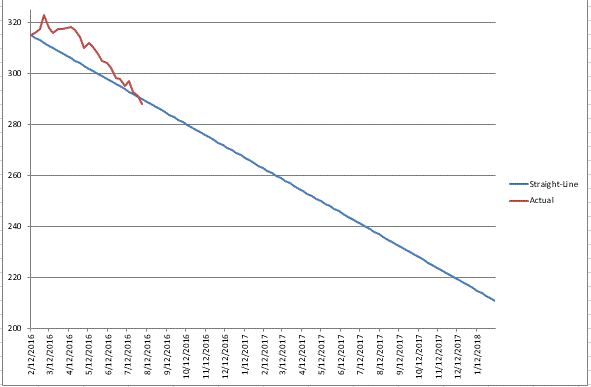
“Straight-Line” is my benchmark weight based on a pound-a-week weight loss
And this is what it looks like visually (updated with last week’s weigh-in):
Next, it is time to start thinking about exercise. I need to balance a few things here. First, I want to exercise as much as I can without taking away from my family time at all. I have a 4-year old and a 1-year old, and I see them for about an hour and a half a day on a weekday, and then weekends. I don’t want to give that precious time up. So, I work out in the mornings, and I work out during the week. When I started a few weeks ago, I was working out Monday – Friday; beginning last week, I have also added a Saturday morning long run that usually finishes before the rest of the house wakes up.
I also need to balance the activities themselves. Before, when I lost all of the weight, I was only running. That’s fine to a point, but is not complete. I want my body to be more efficient and have a kind of strength that is more broadly functional. But I am not good at cross-training. Enter Crossfit. When I started a few weeks ago, the idea was to go to the gym Monday, Tuesday, Wednesday, & Friday, and run on Thursdays. Then add in the long run on Saturdays. And then, as I got closer to goal races, swap out one of the gym days for running days. That schedule is flexible for business travel & vacation, and has also changed around a bit since I’m not going into the gym on testing days for the new levels system.
The key here, though, is to plan this out as far in advance as I can. There is a whole line of thought in economics about how to make the long-term planner in you commit the short-term do-er in you to do things it might not particularly want to at the time. One trick is called a commitment device, and mine is a calendar that I have planned out all the way through any upcoming goal. It looks like this:
And this is planned out this way all the way through the Gasparilla Distance Classic Half Marathon at the end of February. I color code things – you can see when I mark something as having been completed – and generally use this to be able to mentally prepare for what is coming and also adjust for any changes in schedule. Importantly, this keeps me tied to daily exercise. As an example, my calendar shows that I have not missed a weekday workout in over 16 weeks. That has reached a point that any blank space on this thing is going to be a glaring failure for me going forward – and so, when the alarm goes off, I get up.
So now what is left is tracking the exercise itself. My spreadsheet has not yet evolved to track the numbers associated with Crossfit. Two reasons for that – one is that they can be a touch hard to track, and another is that the gym uses a service called Wodify that does a lot of that for you. As an example, this morning we did a 15 minute 3-rep Power Snatch EMOM at 70% (yeah, I don’t know what that means either, but it sure sounds hard). When I log what I did for that, I get this – which I can refer to the next time it is time to do Power Snatches:
And then there are the runs.
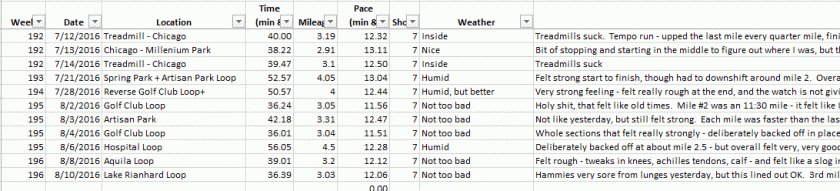
I use a Garmin Forerunner 410 that I’ve had for a few years now – I like it; it works. I use MapMyRun to plan out distances. And I use training schedules from people like Hal Higdon to figure out a basic approach to training for things. And then I do a couple of things. Each time I run, I log it:
I have this going all the way back to my first run in 2012. Sometimes it is fun to go back through and read the Notes…
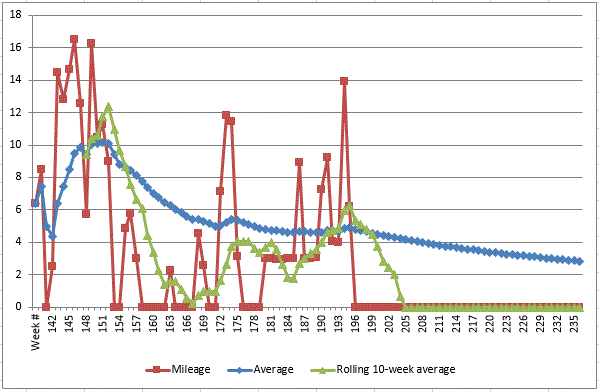
This allows me to do several things. First, it is a place to keep thoughts and look for patterns in terms of things like injury, etc. Second, it allows me to track my weekly mileage and my speed improvement over time. Third, it allows me to track total mileage on my shoes and just in general. So, it allows me to do things like this:
And this:
So that I know where I am at any given time and can see patterns.
I know there are many other things that could be tracked here. One of the reasons I have not gotten a heart rate monitor is that I know that an influx of data like that could be dangerous for my tendency to over-analyze.
There are downsides to all of this, of course. Anymore I feel like I can’t go for a run if I don’t have my Garmin – it is almost like it doesn’t count. That is a silly, but very real, consequence of wanting to have all of the data to crunch. There is also a time element to this, though most of the time is spent in the initial setting-up of the spreadsheet. Now that I have it, in general this is pretty seamless.
Anyway – that’s how I do it. Would love to hear how you do it. And also any suggestions for extending this kind of analysis and measurement to food.




 You can see why I might be a touch self-conscious about ever being seen without a shirt on. But, by having taken those pictures, I get to do two things. First, I get to celebrate how much progress has been made. But also, I get an objective look at how much progress there still is to go. I get real visual reminders that I’m not done yet, and not to act like it.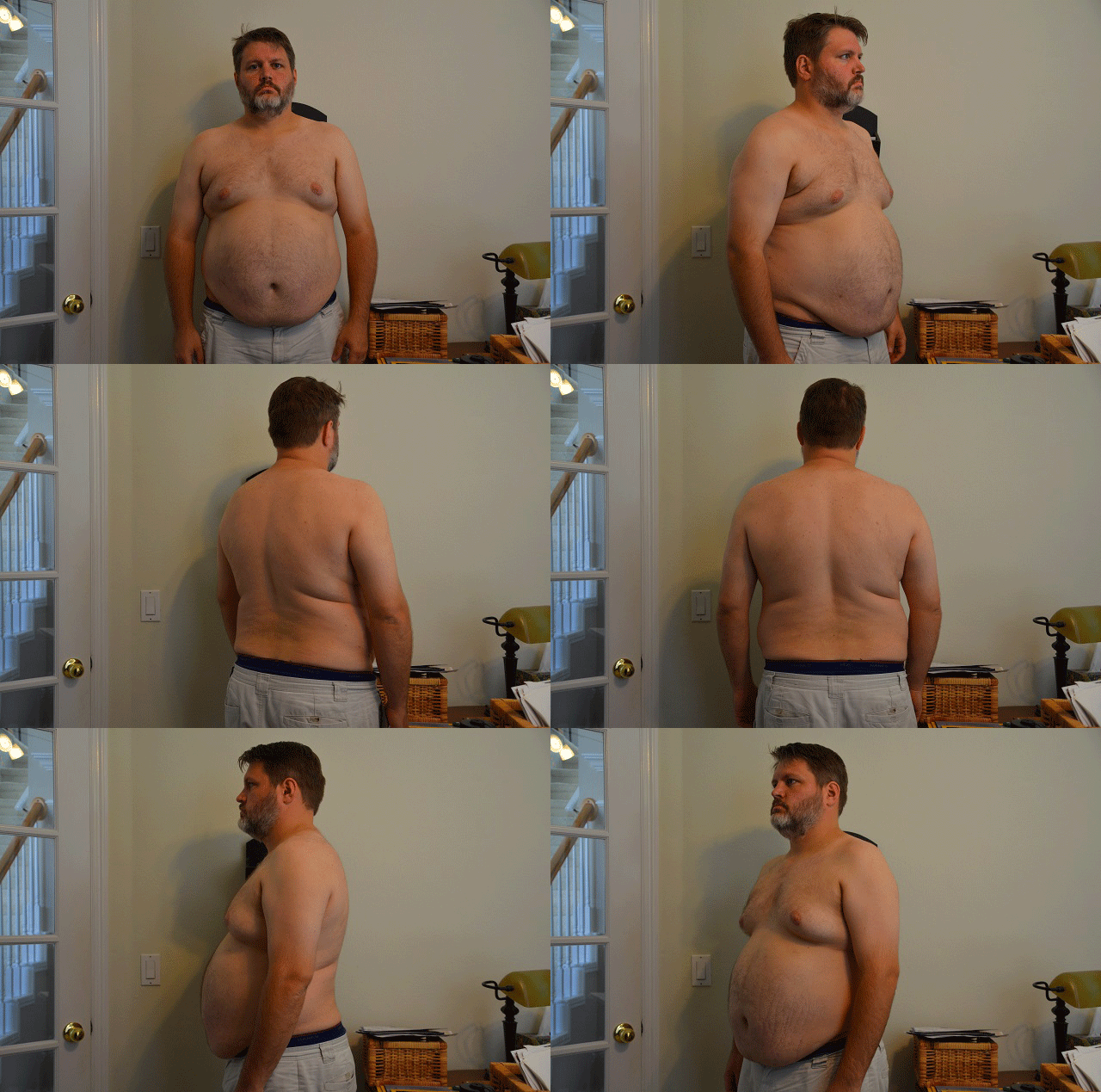
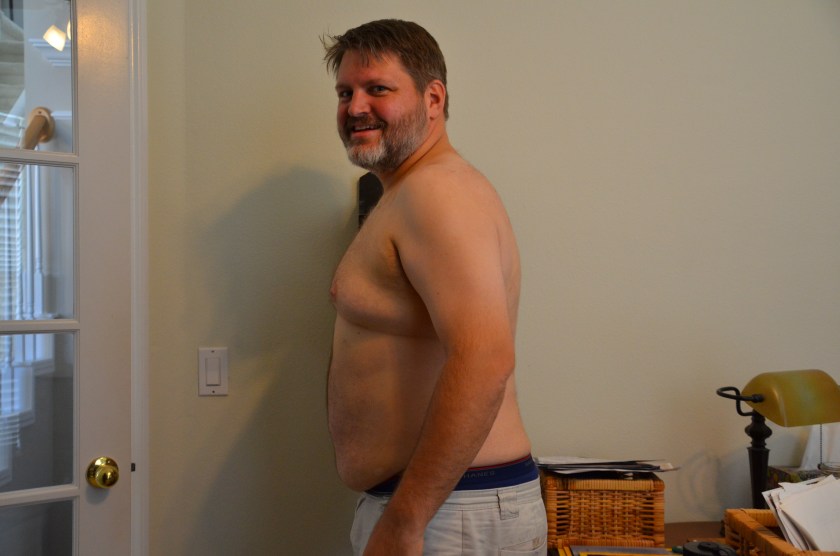




 A Constant State of Hunger